🔈Design bunker edges, without limits. Check out the new Edgevantage now.


🔈Design bunker edges, without limits. Check out the new Edgevantage now.
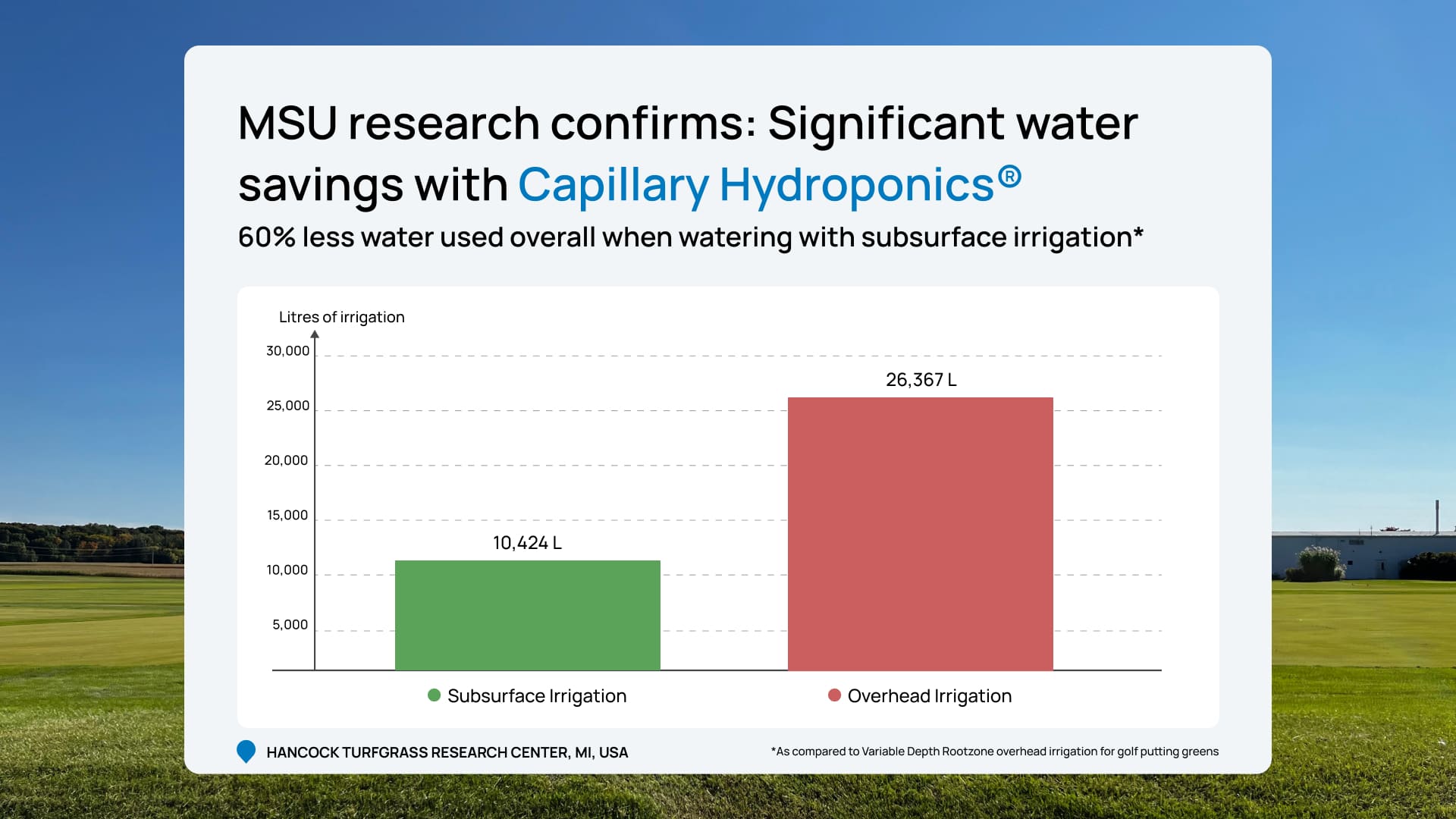


In June 2022, Michigan State University’s Hancock Turfgrass Research Center, which has been at the cutting-edge of turfgrass research since 1978, initiated a study to compare CapillaryFlow’s Hydroponics System (CHS) with the Variable Depth Rootzone (VDR) overhead irrigation for golf putting greens.
The study compared irrigation water applied to maintain volumetric moisture content (VMC) at 8% collecting data comparing soil moisture uniformity, playability factors such as green speed, surface firmness, clipping yield, pest observations, nutrient holding capacity, organic matter build-up, and drainage water nutrient content.
CapillaryFlow was confident that the MSU research would confirm its findings that CHS saved a considerable amount of water as compared to traditional irrigation methods. The good news is that the study's first official findings indeed validate CapillaryFlow’s confidence.
“The results have been very good; they prove that the future belongs to sub-surface irrigation, and in particular hydroponics,” said Martin Sternberg, founder and CEO of CapillaryFlow. “We knew from experience that sub-surface irrigation is significantly more effective than overhead irrigation. But obtaining precise numbers and validating additional benefits of the hydroponic system through a scientific study allows us to quantify and demonstrate this. I believe that they can be even better the second year as we learn how to fine tune the system.”
He added: “If we are to have natural grass in urban areas in the future, we have to find ways to use much less water. The Capillary Hydroponics system is a great way to do this.”
“The results are extremely positive after one summer,” said world-renowned turfgrass scientist Dr Thomas A Nikolai, who is spearheading the MSU study. “Water conservation is THE problem right now. Not just for golf courses, but everywhere… I have little doubt that somewhere in the future greens will be constructed with the CHS beginning in top-end golf courses…”
He added: “The reason for my confidence is the need to avoid wasting water by utilizing it more efficiently and the fact that we are performing scientifically sound replicated research which will lead to answers for future managers of the system”.
In this article, we will reveal the study’s results and also explore how CapillaryFlow's Hydroponic System for greens, tees, pitches and other sport grass surfaces might just be the game-changer the sports industry has been waiting for. After all, this innovation isn't just about putting greens; it's about reshaping the very foundation of sports turf management.
Golf courses and other sports facilities encounter unique challenges in cultivating and sustaining healthy grass. One prominent challenge is around water, a critical resource that becomes even more crucial in regions susceptible to drought and changing weather patterns. The second challenge involves managing playability, a key factor in the success of any sports facility. Ensuring that the grass remains resilient and playable throughout the entire season is a complex task, as any sports ground superintendent will attest. Below, we elaborate on these two challenges.
In past decades, the golf industry in particular has come under sustained scrutiny for wastage of water due to inefficient irrigation systems. US golf courses, for instance, require 2.27 trillion liters of water yearly for irrigation. The cost of this is significant – up to $1,000 per million liters. In recent years, scrutiny over water usage has intensified due to changing weather patterns that have led to prolonged drought conditions in many parts of the world, including western US. The public perception of golf courses watering seemingly lush greens and fairways amidst dry environs has not helped. These are just some of the reasons why several US states including California, Arizona, and Nevada directed golf courses to reduce water consumption and implement more sustainable maintenance practices for water saving as far back as 2014. And starting January 1, 2024, golf courses in the Las Vegas Valley Water District (LVVWD) will operate under a revised water budget after authorities significantly reduced the allotted water budget for golf courses from 6.3 acre-feet per year to 4.0 acre-feet per year.
Conscious of this challenge, the golf industry has been actively working to save water. The United States Golf Association (USGA) has made water saving a top priority, earmarking $30 million over the next 15 years towards the advancement of technologies that will aid in reducing water usage on golf courses. Enterprising golf superintendents across the country have also adopted sustainable practices such as using recycled water for irrigation, growing drought-resistant grass, investing and participating in research for water-efficient growing techniques and grass varieties, and installing smart irrigation systems to save water.
There is no doubt that these efforts to save water are working. US golf facilities applied approximately 1.68 million acre-feet of water in 2020, a 29% reduction since 2005, according to a 2021 survey conducted by the Golf Course Superintendents Association of America. Two-thirds of the reduction was likely a result of operational golf facilities applying water more efficiently, said the report.
The bad news is that this is not enough. As water shortages continue to persist and even worsen in some areas, more innovative and disruptive solutions are needed to address the urgent need for water savings in the sports industry.
The second challenge is to achieve resilient and robust growth while conserving water and, simultaneously, to sustain this growth throughout the entire season while ensuring optimal playability.
A major obstacle faced by greenkeepers, superintendents, and turf managers worldwide in meeting these objectives is the presence of organic material in the root zone. Compaction or excessive moisture retention caused by organic material obstructs proper drainage, leading to waterlogged surfaces during rainfall and significantly compromising the playability of the turf. Addressing this challenge is crucial for maintaining high standards in turf management and enhancing the overall quality of playing surfaces. However, this is also why the conventional approach of cultivating grass in soil consumes a significant portion of maintenance budgets in golf courses, sports pitches, and urban landscapes.
Both these challenges led CapillaryFlow founder and CEO Martin Sternberg to conceive of and design the Capillary Hydroponics System (read the complete origin story here). In 2023, CapillaryFlow celebrated the fifth anniversary of the installation of its first sub-surface irrigation system. Since then, numerous golf courses and sporting venues have witnessed a transformative impact of the system, with one of the most significant benefits being the substantial savings in water consumption – up to 85%, according to CapillaryFlow’s own studies.
The Michigan State University study came about almost serendipitously because Sternberg was keen on scientific evidence that his system indeed saved much more water than conventional irrigation methods. “We want to scientifically prove the water savings,” said Sternberg when the research project took off in 2022. “We want to scientifically prove the cleaning effects – that less fertilizers and pesticides are being used and there is less leaching. Basically, we wanted to prove all the benefits of the hydroponic system in a scientific manner.”
In the next section, we talk about the methodology and the results of the research project.
Six research greens, designed to replicate golf course conditions, were constructed at the Hancock Turfgrass Research Center at Michigan State University. Two treatments, Variable Depth Rootzone (VDR) and Capillary Hydroponics System (CHS), were employed. The VDR greens adhered to USGA specifications, with rootzone depth varying from 20 cm at the top of slopes to 40 cm in low points. Drainage for each variable depth green was collected and analyzed. The Capillary Hydroponics System utilized inlet pipes below the frost line, connected to a control basin with an impermeable liner, gravel, and Capillary Material for water distribution. The greens cavity was divided into two halves, with water continually transferred between them on a customizable schedule. The water table was maintained at 20 cm below the surface.
All greens were constructed with the same sand conforming to USGA specification with no organic matter and incorporations and seeded with T1 Creeping Bentgrass on June 15, 2022. The trials were not initiated until turf was fully established approximately 12 months later. Both systems were maintained at 8% VMC, to achieve this. The Variable Depth Rootzone greens were watered to return 80% ET and the Capillary Hydroponic System greens were set to maintain a water table at 20 cm below the surface of the lowest point of the green.
Besides water, measurements of soil moisture, green speed, clipping weight, surface firmness were taken throughout the study period.
There is no significant difference in playability between the Capillary Hydroponics System and the Variable Depth Rootzone greens concerning green speed or surface firmness.
Overall, 60% reduction in water usage
The Capillary Hydroponic System used 60% less water than the Variable Depth Rootzone system over a 10-week period starting June 2023.
The Capillary Hydroponic System collects water during rainfall. So, the study identified three trends when precipitation is considered.
1. High or frequent precipitation and low evapotranspiration
The hydroponic system used 83% less water than the Variable Depth System during an 11-day period with high and frequent precipitation (about 0.77 cm per day), and lower evapotranspiration (about 0.25 cm per day).
2. Moderate or frequent precipitation and high evapotranspiration
The hydroponic system used 77% less water than the Variable Depth System during an 11-day period with moderate and frequent precipitation (about 0.44 cm per day), and high evapotranspiration (about 0.31 cm per day).
3. Low precipitation and high evapotranspiration
The hydroponic system used 42% less water than the Variable Depth System during an 11-day period when precipitation was low (approximately 0.14 cm per day), and evapotranspiration was high (about 0.31 cm per day).
For more details on the MSU study, read:
● Why CapillaryFlow is seeking scientific validation for its hydroponics system
● Putting green construction project at Michigan State University
Sternberg is optimistic that the success of the Capillary Hydroponics System will help validate all the work the golf industry has done in optimizing grass growth and irrigation in past decades. “I hope the success of our system accelerates the shift towards sub-surface irrigation, allowing us to continue perfecting these systems,” he said. “Our goal is to use this technology in the future to prove the golf industry’s worth and benefit to society. Despite driving innovations in grass growth and irrigation systems for decades, the golf industry has not received due credit. This system represents a significant improvement, and I am optimistic that we can leverage it to benefit golf and change the public perception of the sport as a negative impact on the environment as a whole.”
Dr Nikolai was excited about future possibilities too.
“We began with a specific point, outlining our approach,” he said. “We could explore variations like considering a volumetric moisture content of 10% instead of eight, examining how that might impact the differences between the systems. The ongoing tweaking of the system is essential to continually discover advantages for end-users, whether they're in a football stadium, a racetrack, a horse racetrack, a park, or a golf course. This process is perpetual, reflecting the nature of research.”
Discussing the direction of research in the coming year, Mike Rabe, graduate student conducting the research project and assistant manager of the Hancock Turfgrass Research Center, said: “Our focus remains examining irrigation water use. But going ahead, we could consider adding another layer to the study, possibly incorporating elements like conventional USGA rootzone and Capillary Geothermal. Personally, I find exploring root zone temperature during colder seasons to be highly intriguing.”
Rabe added, “We are also studying the uniformity of moisture between the two systems. We are already collecting data for that. I also firmly believe that the next crucial phase involves comparing the direct application of fertilizer to the roots versus foliar fertilization.”
Dr Nikolai said he was excited about the learnings the research would provide. “As this study progresses, as more and more research is performed, I believe it will provide BMPs that minimize pests,” he said. “The way the system is built, we will probably be able to apply bacteria into the basin and feed it underneath as opposed to fungicide. There's a great deal to learn and that is exciting.”
Dr Nikolai concluded, saying: “I'll know on my deathbed I was part of it in the beginning and that makes me smile.”
Are you interested in how we can help you acheive substantial water savings when constructing a green or tee box? Contact us!

CapillaryFlow makes it possible to design baseball fields that are able to withstand tough playing conditions as well as ensure a healthy game experience for players.

Our proprietary Capillary Material makes it possible to have a bunker liner that rapidly drain while also retaining adequate sand moisture, creating the perfect playing conditions in golf course bunkers.

The Capillary Hydroponics system enables us to grow strong and durable grass with significantly less maintenance and environmental impact

Optimal riding conditions in any weather by providing a ground material technology offering superior drainage capacity and enabling use of subsurface moisture control - for the optimal footing

Capillary Hydroponic turf lengthens the season with natural strong grass that stays healthier even with a busy schedule

Our Capillary Hydroponics solution turns hardscaped surfaces into breathable, living spaces that augment the positive effects of greenery in urban environments.


