🔈Design bunker edges, without limits. Check out the new Edgevantage now.


🔈Design bunker edges, without limits. Check out the new Edgevantage now.



How deep should sand be installed in my golf bunkers? What is the best sand for my bunkers? Neither question has a single answer. The physical properties of the available sand determine how the material drains, retains moisture, packs, and resists movement; those behaviors, together with regional conditions, should then guide installation depth. Together, these factors determine playability, drainage, moisture behavior, and long-term maintenance needs. For that reason, selecting bunker sand is best approached as a system: first identify a suitable material based on its physical characteristics, then use those characteristics and site conditions to determine an appropriate depth, and finally consider how construction and maintenance can preserve performance over time.
Sand depth should not be selected independently of sand properties. Size, gradation, shape, sphericity, and composition influence how particles pack, how water moves through and is retained within the profile, and how resistant the surface is to movement (Marshall and Lindsay, 2010). Particle size distribution (PSD) describes the proportions of different particle sizes within a sample, while angularity describes the sharpness of particle edges, and sphericity describes how closely the overall particle shape resembles a sphere. Together, these characteristics influence pore space, interparticle friction, drainage, moisture retention, firmness, and ultimately the stability of the bunker sand for play.
Sand that is too coarse and uniform can be unstable and prone to “blasting” out of the bunker, while material that is too fine or contains excessive silt or clay can drain poorly and require greater maintenance (Brown and Thomas, 1986). The goal of bunker sand selection is therefore not to maximize any single property, but to identify a balance: sufficient firmness and interparticle friction for stability, adequate drainage, and enough moisture retention to support consistent play without prolonged wetness, crusting, or algal growth. This need to evaluate properties collectively is also reflected in the evolution of USGA bunker sand guidance.
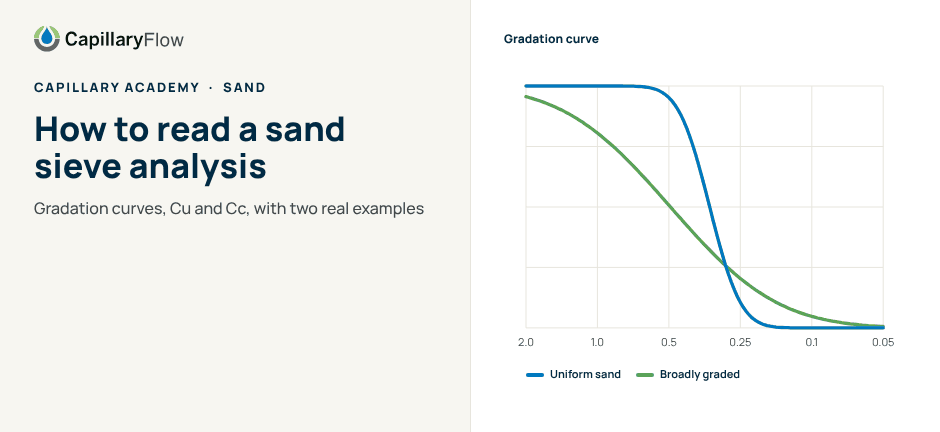
Early USGA bunker sand guidance placed substantial emphasis on PSD and favored particle fractions between 0.25 and 1.0 mm, with 75% between 0.25 and 0.5 mm (USGA Green Section Staff, 1977). Later recommendations broadened the acceptable range to 78–100% between 0.1 and 1.0 mm and placed greater emphasis on evaluating other physical properties alongside PSD (Brown and Thomas, 1986; Whitlark, 2020). These include coefficient of uniformity (CU), infiltration rate, angle of repose, angularity, sphericity, and moisture retention, all of which contribute to bunker playability (Table 1).
The interaction among these properties is what ultimately matters. A well-graded sand with angular particles, for example, can produce firmer playing conditions (Bigelow and Smith, 2008). Smaller fractions fill portions of the pore space between larger particles, while angular edges increase interparticle friction and interlocking, generally increasing resistance to movement. However, too many fine particles can reduce drainage and promote crusting, prolonged wetness, and algal growth, particularly in conducive golf-course microclimates. Thus, a characteristic that improves stability can become detrimental when taken too far.
For golf courses researching “USGA bunker sand specs” or “golf sand trap specifications,” an acceptable particle-size range is therefore only one part of the assessment. Just as importantly, bunker guidance should not be confused with USGA putting green construction specifications. Bunkers and putting-green root zones serve fundamentally different functions, so the specifications for one should not be applied to the other. Within bunker evaluation itself, one of the most useful indicators of particle stability—especially on faces—is angle of repose.
Angle of repose describes the angle at which a loose pile of material remains stable under the test conditions, providing an indication of resistance to particle movement (Al-Hashemi and Al-Amoudi, 2018). In simulated bunker-rainfall testing, sands with a higher angle of repose have generally been less susceptible to erosion (Nemitz et al., 2007). More angular sands also tend to have a higher angle of repose because increased interparticle friction and particle irregularity promote interlocking (Van Burkalow, 1945; Carrigy, 1970).

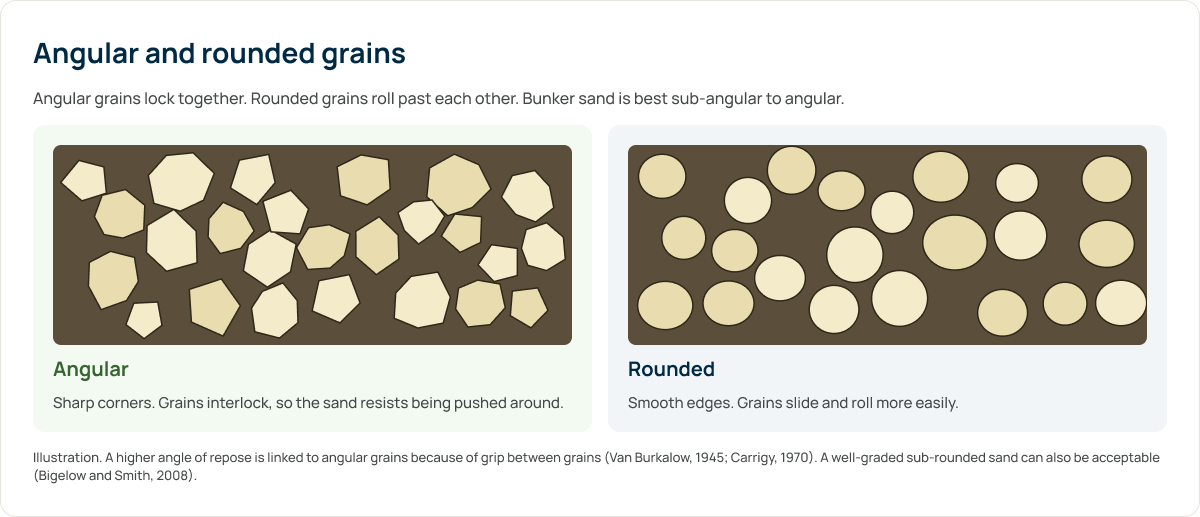
These relationships are particularly relevant on bunker faces, where particle stability directly affects sand movement and maintenance requirements. Angle of repose, however, is not a stand-alone predictor of washout. Face slope, rainfall intensity, runoff, and the underlying construction all influence erosion. Taken together, the physical properties discussed above establish how a selected sand is likely to drain, retain moisture, and resist movement. Those same behaviors then provide the basis for determining an appropriate installation depth.
Once a suitable sand has been identified, installation depth becomes the next important decision. In an ideal bunker, sand is installed as shallow as practically allowed to avoid plugging—a “fried-egg” lie—while maintaining sufficient coverage over the subsurface for play (Beard, 1998). Traditional recommendations commonly prescribe 4–6 in. (100–150 mm) at the bunker floor and 2–3 in. (50–75 mm) on faces. Shallower faces encourage the ball to roll toward the bunker floor rather than remain on the slope, limiting play and associated maintenance along bunker edges. However, if sand is installed too shallow for the properties of the selected material and the site conditions, it becomes more susceptible to washout, displacement, and the need for replacement at both the base and faces.
That tradeoff becomes especially important in regions with high precipitation during the playing season and on open, links-style courses exposed to wind erosion. Depth selection therefore must balance playability with the local environment, but that balance is ultimately governed by how the chosen sand stores and releases water. An adequate depth should allow the playing surface to dry sufficiently for play and resist algal growth while still providing a buffer against sand loss and displacement. Because different sands behave differently at the same depth, laboratory moisture testing provides a more defensible basis than a fixed rule of thumb.
Gietka (2024) and the USGA currently recommend using a moisture-column test through an accredited laboratory to guide depth selection. In this test, the sand is saturated and its moisture content is tracked as it drains over 48 hours. The suggested minimum floor depth is 1 in. (25 mm) greater than the height at which the sand dries to 15% moisture at 48 hours. Using this method can soundly push bunker sand installation depth outside of the widely accepted 4-6” range. For example, if a sand reaches 15% moisture 6 inches above the bottom of the column after 48 hours, the recommended minimum installation depth would be 7 inches. This approach ties installation depth directly to the moisture characteristics of the selected material rather than to a universal depth recommendation.
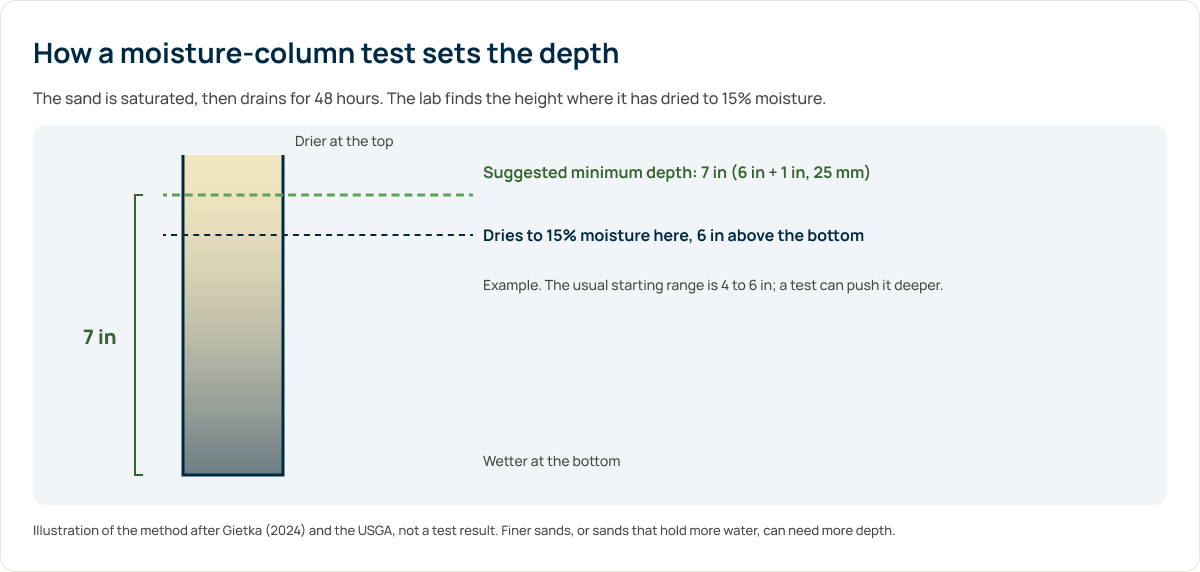
Accordingly, finer sands or sands with greater water retention and meso- and microporosity may require greater depth to achieve acceptable surface-moisture conditions through sufficient dry-down and adequate drainage. Yet particle size alone does not determine whether a bunker will be firm or prone to plugging. Gradation, particle shape, moisture, and maintenance all contribute to how the surface plays. Moisture-column testing should therefore guide the final depth decision, while regional climate can be used as a practical starting point during early planning.
Before moisture-column results are available, Table 2 provides a proposed starting point for considering installation depth in relation to regional precipitation, assuming a suitable sand source with the characteristics described earlier in this article. Annual precipitation is only a planning variable; rainfall intensity and seasonal distribution, irrigation coverage, shade, wind, and drying conditions can substantially alter how a bunker behaves. A course with relatively low annual rainfall, for example, may still experience intense storms capable of producing substantial sand displacement.
Moisture-column results should take precedence over this rainfall-based starting point. If testing indicates that greater depth is required, the installation should reflect that finding. These suggested depths apply to bunker bases; faces require separate consideration of slope, sand stability, and coverage. At this point, sand selection and depth have been considered together: the material determines how it behaves, testing helps translate that behavior into an appropriate depth, and site conditions refine the decision. The remaining challenge is preserving those selected characteristics after construction and through long-term use.
Even a well-selected sand installed at an appropriate depth does not remain unchanged indefinitely. Soil, fine particles, and organic materials such as leaf debris can accumulate over time, progressively altering drainage, moisture retention, firmness, and playability. Protecting the characteristics identified during sand selection therefore becomes the next part of the process. This is achieved on several fronts by the CapillaryFlow bunker system.
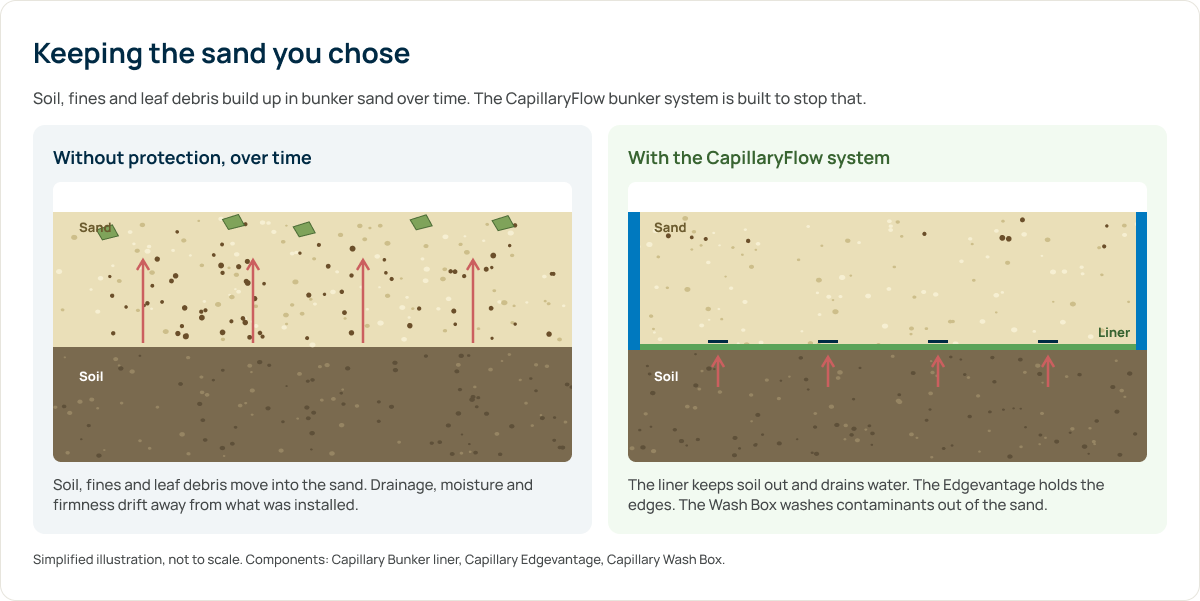
The CapillaryFlow bunker system is designed to support long-term performance through several complementary components. The patented Capillary Bunker liner material separates the bunker sand from the underlying soil, provides exceptional drainage, protects against washout along bunker faces, and helps maintain uniform and consistent sand moisture across the bunker. The Capillary Edgevantage provides additional support along bunker edges and helps maintain bunker shape and integrity through use and maintenance. The Capillary Wash Box helps extend the useful life of bunker sand by allowing accumulated contaminants to be washed from the sand without requiring costly removal and replacement.
Together, these components help preserve the physical characteristics of the original bunker sand and maintain the conditions established at installation.
Moisture management of sand is a key determinant of consistent play from the bunker. By moving excess water down and away after storms while retaining capillary moisture near the surface, the CapillaryFlow bunker liner can effectively reduce “swings” in moisture and maintain more consistent moisture conditions. This helps limit the extremes commonly associated with plugged lies, inconsistent firmness, and unstable sand. Such uniformity directly translates to more stable sand conditions between rainfall and irrigation events. While the CapillaryFlow bunker system does not replace sound sand selection, it can help a suitable sand perform as intended and more consistently across a wider range of conditions.
Ultimately, however, consistency should not be confused with prescribing a single ideal bunker condition. Preferences for sand firmness, moisture, and playability vary among golfers and from course to course. Determining the preferred playing condition is therefore best left to the golf course, its professionals, and its membership. The role of the CapillaryFlow bunker system is to help reproduce and preserve those chosen conditions more uniformly—within an individual bunker, from bunker to bunker, and over time.
The system therefore does not dictate the “perfect” sand or moisture condition; rather, it provides a means of maintaining the conditions a course has selected more consistently and for longer periods. Material lost through play, wind, or displacement must still be replenished, and washing cannot correct an unsuitable original sand or an inadequate installation depth. The CapillaryFlow bunker system instead complements the decisions discussed throughout this article: select a suitable sand, establish the proper depth through testing and site-specific planning, and then preserve those conditions through appropriate construction and maintenance. In that sense, long-term bunker performance is not the product of a single specification, but of how sand selection, depth, construction, moisture management, and maintenance work together.
To make the first step—sand evaluation—easier, CapillaryFlow has developed the CapillaryFlow Sand Agent. Users can enter or upload a laboratory sand-analysis report and view the material as a gradation curve alongside USGA particle-size guidance, making it easier to screen candidate sands and compare suppliers side by side. The tool is intended as a starting point for interpreting laboratory data, not as a replacement for accredited testing. If you would like help matching a sand and installation depth to your climate, bunker construction, and CapillaryFlow system, the CapillaryFlow team can help review the project or set up a demo bunker.
Beakawi Al-Hashemi, H. M., & Baghabra Al-Amoudi, O. S. (2018). A review on the angle of repose of granular materials. Powder Technology, 330, 397–417. https://pure.kfupm.edu.sa/en/publications/a-review-on-the-angle-of-repose-of-granular-materials/
Beard, J. B. (1998). Turf management for golf courses (2nd ed.). Ann Arbor Press.
Beard, J. B., & Beard, H. J. (2005). Beard’s turfgrass encyclopedia for golf courses, grounds, lawns, sports fields. Michigan State University Press.
Bigelow, C. A., & Smith, D. R. (2008). Physical analysis of sands for golf course bunker use. USGA Turfgrass and Environmental Research Online, 7(3), 1–10. https://usgatero.msu.edu/v07/n03.pdf
Brown, K. W., & Thomas, J. C. (1986, July). Bunker sand selection. Golf Course Management, 54(7), 64–70.
Carrigy, M. A. (1970). Experiments on the angles of repose of granular materials. Sedimentology, 14(3–4), 147–158.
Gietka, B. (2024, April 19). Deep thoughts about bunker sand depth. USGA Green Section Record, 62(7). https://www.usga.org/content/usga/home-page/course-care/green-section-record/62/issue-07/deep-thoughts-about-bunker-sand-depth.html
Marshall, R. I., & Lindsay, M. R. (2010). A comparative study of the properties of bunker sands from links and inland championship golf courses in Great Britain and Ireland. In A. J. Cochran (Ed.), Science and golf (Routledge revivals): Proceedings of the first World Scientific Congress of Golf (pp. 346–351). Routledge. (Original work published 1990)
Nemitz, J., Bigelow, C., Moeller, A., Hardebeck, G., Walker, K., & Smith, D. R. (2007, November 4–8). Erosion potential of various golf course bunker sands [Conference abstract]. ASA–CSSA–SSSA International Annual Meetings, New Orleans, LA, United States. https://crops.confex.com/crops/2007am/techprogram/P35200.HTM
USGA Green Section Staff. (1977, November/December). Topdressing mixtures: The Green Section’s position. USGA Green Section Record, 15(6), 5–8.
Van Burkalow, A. (1945). Angle of repose and angle of sliding friction: An experimental study. Geological Society of America Bulletin, 56(6), 669–707.
Whitlark, B. (2020, June 5). A guide to selecting the right bunker sand for your course. USGA Green Section Record, 58(11). https://www.usga.org/content/usga/home-page/course-care/green-section-record/58/11/a-guide-to-selecting-the-right-bunker-sand-for-your-course-.html
Whitlark, B. (2025, November 21). Algae in bunkers: Why it shows up and how to fix it. USGA Green Section Record, 63(21). https://www.usga.org/content/usga/home-page/course-care/green-section-record/63/issue-21/algae-in-bunkers--why-it-shows-up-and-how-to-fix-it.html